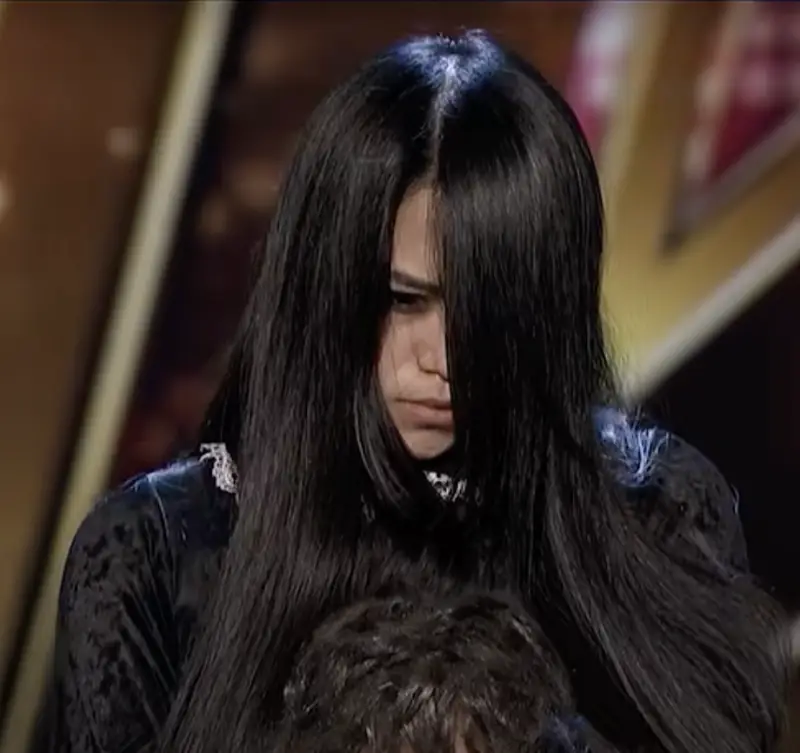
Some auditions are fun, some are emotional — and some feel so unusual that they blur the line between performance and storytelling. This act is one of those rare moments where imagination, acting, and atmosphere come together in a way that feels almost cinematic.
From the beginning, the stage had a dark and eerie tone. A young female contestant stepped forward with a quiet and unsettling presence. The lighting and visuals immediately suggested that this would not be a typical talent performance.
The introduction set a strange and intriguing concept: she mentioned her “imaginary friend.” This instantly changed the atmosphere in the room. The judges became more attentive, unsure whether this would be a theatrical performance, a psychological storytelling act, or something entirely unexpected.
As the performance began, the tone leaned heavily into a dramatic and almost horror-like aesthetic. The stage design and lighting reinforced this feeling, creating a visual atmosphere similar to a cinematic scene rather than a standard audition.
One of the most striking aspects of this performance was how immersive it felt. The contestant’s expressions and movements suggested a deep emotional connection to the narrative she was portraying.
The phrase “my imaginary friend likes…” introduced an unsettling layer of storytelling. Instead of a simple explanation, the performance built a sense of mystery around the unseen presence being described.
As the act continued, the audience became more focused. Silence in the room increased, and viewers seemed unsure how to interpret what they were witnessing. This kind of reaction is often a sign that a performance is successfully creating tension and curiosity.
The judges also reacted with visible uncertainty. Their expressions suggested that they were trying to determine whether this was purely acting, psychological storytelling, or a symbolic performance.
The stage visuals played a major role in shaping the mood. Dark lighting, minimal movement, and slow pacing contributed to a feeling similar to a horror short film or dramatic monologue.
As the performance developed, the concept of the “imaginary friend” became more central. The unseen presence seemed to influence the narrative, even though nothing physical was visible on stage. This created a psychological layer to the act.
One of the strongest elements of this audition was its ability to maintain tension without traditional performance elements like singing or dancing. Instead, it relied on atmosphere, expression, and storytelling.
The audience reaction remained mixed — curiosity, confusion, and fascination blended together as the act progressed. This kind of emotional ambiguity often makes performances more memorable.
As the performance approached its later moments, the emotional intensity increased. The contrast between innocence and darkness became more pronounced, reinforcing the unsettling tone of the act.
By the end of the audition, the stage felt less like a competition space and more like a theatrical scene from a psychological drama. The performance left viewers thinking rather than reacting immediately.
This audition is a reminder that talent shows are not limited to traditional categories. They can also become platforms for experimental storytelling that challenges perception and emotion.
In the end, this wasn’t just an audition about an imaginary friend. It was a dark, cinematic performance that turned a simple concept into an atmospheric and unforgettable stage moment.