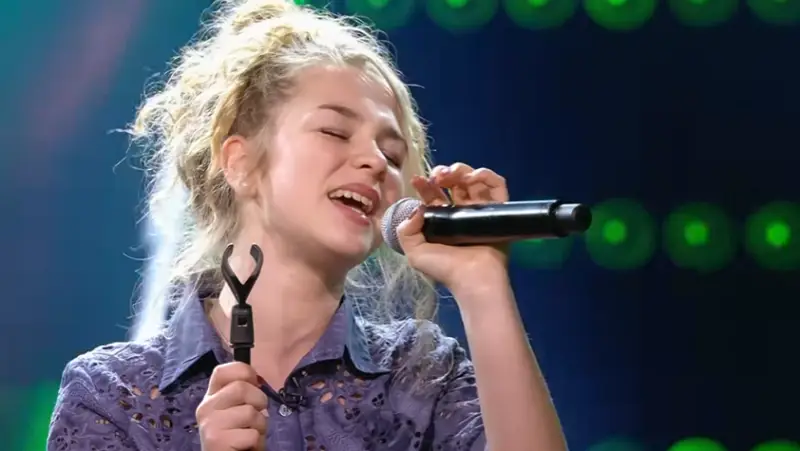
When Luka Cruysberghs first appeared on The Voice van Vlaanderen in 2017, she was only 16. She walked onto the stage visibly tense, yet fully committed. Her version of “Sweet Dreams” was shadowy and intense, drawing from Marilyn Manson’s interpretation rather than the original. The risk paid off immediately. Every coach turned their chair, and Luka selected Alex Callier of Hooverphonic as her mentor. That decision would soon influence the direction of her career.
By the close of the season, Luka had claimed the title. She became the youngest winner in the show’s Flemish history. Still, victory was only the beginning. Fame arrived quickly, but so did demands, expectations, and the realities of a professional music career.
Not long after her win, she was asked to step in as Hooverphonic’s lead vocalist. At 17, she joined an established group with a devoted audience and international plans already in motion. It was an extraordinary chance, and also a major responsibility.
Over the next two years, Luka performed throughout Europe, the United States, and Japan. She appeared on large stages, sang for crowds of thousands, and learned at a pace few young musicians ever experience. Even so, the journey was not entirely easy.
In late 2020, the band revealed that Geike Arnaert would return as singer, and Luka would leave. According to Luka, she learned this only an hour before the announcement, during a Zoom call. The way it unfolded hurt deeply. It ended an important chapter, but the manner of the decision also made it feel impersonal and transactional.
Rebuilding Her Career, On Her Own Terms

Source: Screenshot from the official The Voice van Vlaanderen YouTube channel
After her departure from Hooverphonic, Luka faced a clear crossroads. She could leave music behind, or she could begin again and discover a voice that belonged entirely to her. She chose the second path.
Her first solo release, “Not Too Late”, arrived in 2021. Later came the Insomnia EP, and in 2024 she issued her debut full-length album, Need You In The Light. The sound became more restrained, less polished, and noticeably more personal.
This was more than a musical adjustment. It was a change in ownership. Luka declined offers from major labels and preferred independence instead. She assembled a small team, financed her own work, and pursued the songs she genuinely wanted to record. That choice brought fewer guarantees, smaller venues, and slower momentum, but it also gave her control.
One of her most intimate compositions is the album’s title track, Need You In The Light. She wrote it about her grandmother, who died after a long battle with Alzheimer’s. The song is gentle and exposed, serving less as a showcase and more as a personal remembrance.
“Her music has grown out of experience, not image, and that is what gives it weight.”
The loss also inspired her to support Alzheimer’s awareness efforts. Luka became an ambassador for the Alzheimer Research Foundation in Belgium, speaking publicly about memory, identity, and grief. Those ideas continue to surface in her work.
In 2024, she also returned to television, this time as part of a duo named Aqua Riyaz with singer Justin Degryse. Together they entered Sing Again on VTM and advanced to the later rounds with their version of Tamino’s “Habibi”. It served as a quiet reminder that her voice still connects with audiences, even as she shapes her path independently.
Key Insight: Luka’s career has moved from a high-profile television breakthrough to a more private, self-directed artistic journey.
At 24, she is still finding her next direction, but she now does so with greater confidence. She is not pursuing celebrity for its own sake. Instead, she is focusing on honest songwriting, genuine connection, and creative independence. That route can be uncertain, and it offers less security, but it also allows more freedom.
She is no longer the teenager who astonished viewers on The Voice. She has become a young artist building her own future step by step, with a clear sense of what the music business can offer and what it can quietly take away.
No gloss. No pretense. Just music that feels lived in, delivered by an artist whose experience already runs deeper than many expect.
In the end, Luka Cruysberghs’ story is one of early success, difficult change, and thoughtful reinvention. From a striking blind audition to independent releases and advocacy work, she has kept moving forward without abandoning her own voice. Her path shows that growth in music is not always linear, but it can still lead to something honest, lasting, and fully personal.